The CRM that ends at cash, not at a hand-off.
A deal carries priced line items. Those lines become the quote, then the invoice or the subscription, on the same contact record your books already use. No sync, it is the accounting system.
One record, from first call to posted revenue.
Nothing here is an integration. The deal, the quote, the invoice, the entry, and the forecast are rows in the same database, so there is no step where a number gets typed twice.
Price the deal, not just name it.
Pull products and services off your real catalog with quantity, unit price and discount. The deal’s value is the sum of its lines, recomputed on every change and refused as a hand edit. Line math runs through the same function the invoice uses, so a deal line and the invoice line it becomes cannot disagree.
Send the quote. Sign-off happens on the way.
The quote is the deal’s priced proposal, and every send, revision and acceptance lands on the deal timeline by itself. Caytava measures the blended discount across the lines, what you will charge against what it lists for, and anything over your threshold routes to the approver you named. The approval authorizes a number, so re-discounting past it voids it.
Win it, then pick where it goes.
A won deal becomes a draft invoice, a subscription, or a contract, on the same contact record AR and AP already bill. The invoice inherits the deal’s lines, each one snapshotting its item’s revenue account and tax rate. Recurring lines are refused on a one-off invoice and sent to a subscription instead, so nobody charges a year of a monthly plan on day one.
The forecast and the ledger already know.
Stage probabilities are calibrated from your own won and lost history rather than a model’s guess. Won revenue feeds the plan, and the moment a deal is invoiced it drops out of the forecast so the GL actual and the pipeline never count the same dollar twice.
Everything a sales team needs. Nothing re-keyed for finance.
Pipeline and deals
Configurable stages on a drag-and-drop board, with bulk moves, stage merge and reorder, and a default probability per stage. Deals are tagged new business, renewal or expansion, and a deal that sits past its stage’s idle window is flagged as rotting.
- Custom fields on deals, accounts and people, typed and archivable
- Saved views, record ownership, and a visibility policy of Everyone, My team, or Private, enforced on the server
- Pursuit teams for a deal that does not follow the org chart
- Tasks with assignment, a My Tasks view, and due reminders
- Stage-transition history and per-record field history
What the deal is selling
Line items with quantity, price and discount, and a recurrence on the line itself, so a pursuit’s recurring component is modeled before it is ever a subscription. A deal reports three numbers instead of one: what bills once, what recurs, and what the whole contract is worth.
- Usage-based lines with a committed minimum, billed at the greater of consumption or the floor
- The committed floor counts toward MRR and ARR, estimated usage above it never does
- Estimated and committed values reported side by side, clearly labeled
- Deal lines carry no tax, because tax belongs to the document that bills
Stage gates, automation and discount sign-off
Process you can actually enforce, all of it off until you turn it on. A stage names the fields a deal must carry before it may enter, and the block is hard rather than a warning you can click past. Dragging a deal backwards is always free.
- Gate on amount, close date, owner, source, customer PO, entity, or your own custom fields
- Rules fire on deal created, stage entered, or idle N days, and create a task, notify the owner, notify their manager, or assign round robin
- Discount rungs you define, with the approver named by job title, by person, or as the deal owner’s manager on the People reporting line
- No model anywhere near it: exact comparisons over real columns, and every firing writes a run row that is both the audit trail and the reason a rule never fires twice
Quotes and the last mile
A quote is a deal artifact, not a file in a folder. Draft, send, revise a sent quote, accept it or reopen a declined one, with every event logged to the pursuit it prices. Quotes never touch the ledger.
- The items on the quote decide where an acceptance goes: straight to a draft invoice, onto a sales order when goods need staging, or through a contract
- Issuing entity and per-line dimension tags captured internally, never shown to the customer
- A Closing Desk that shows quotes out for acceptance and deals in the paperwork stretch
Accounts, people and prospects
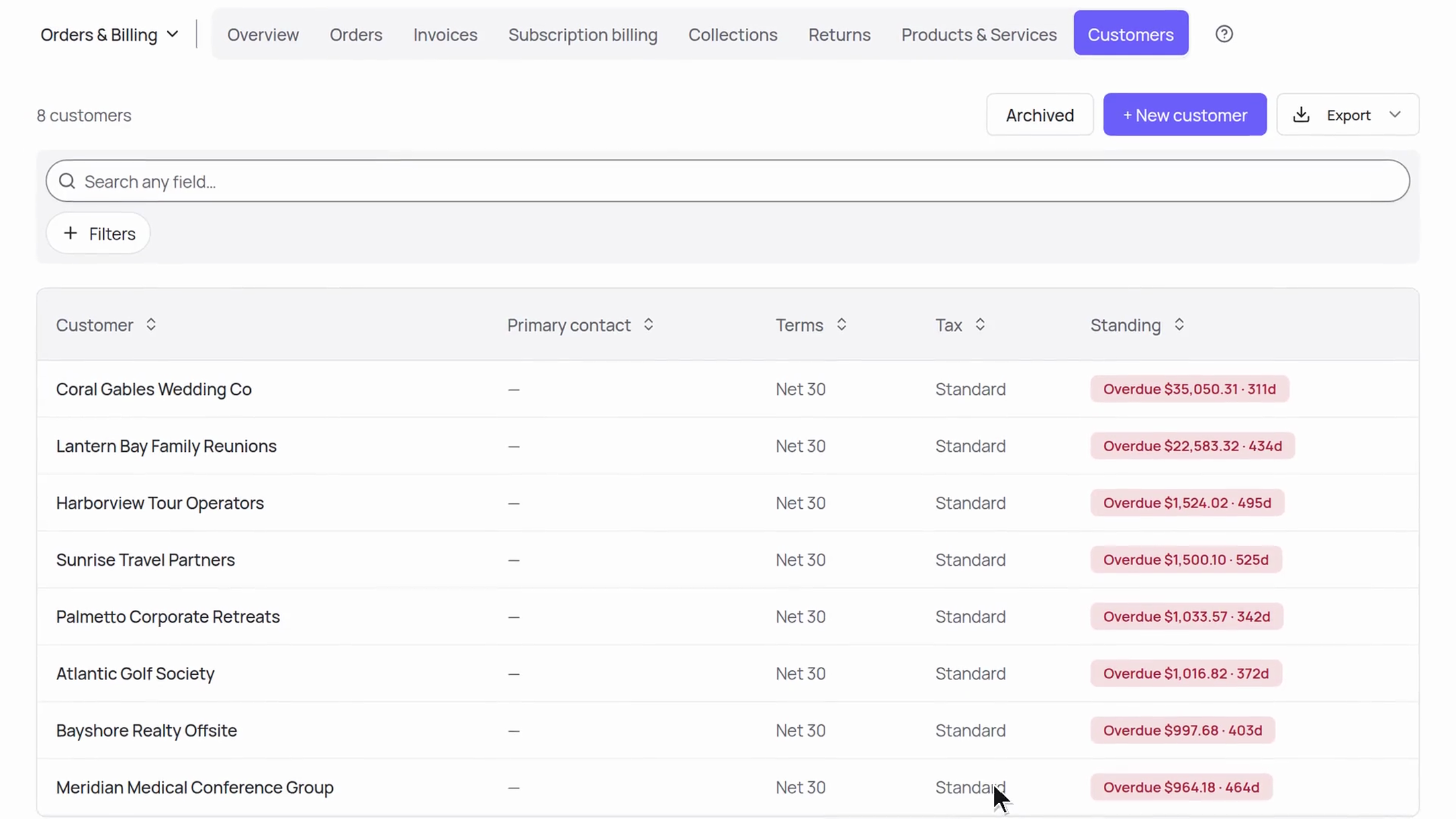
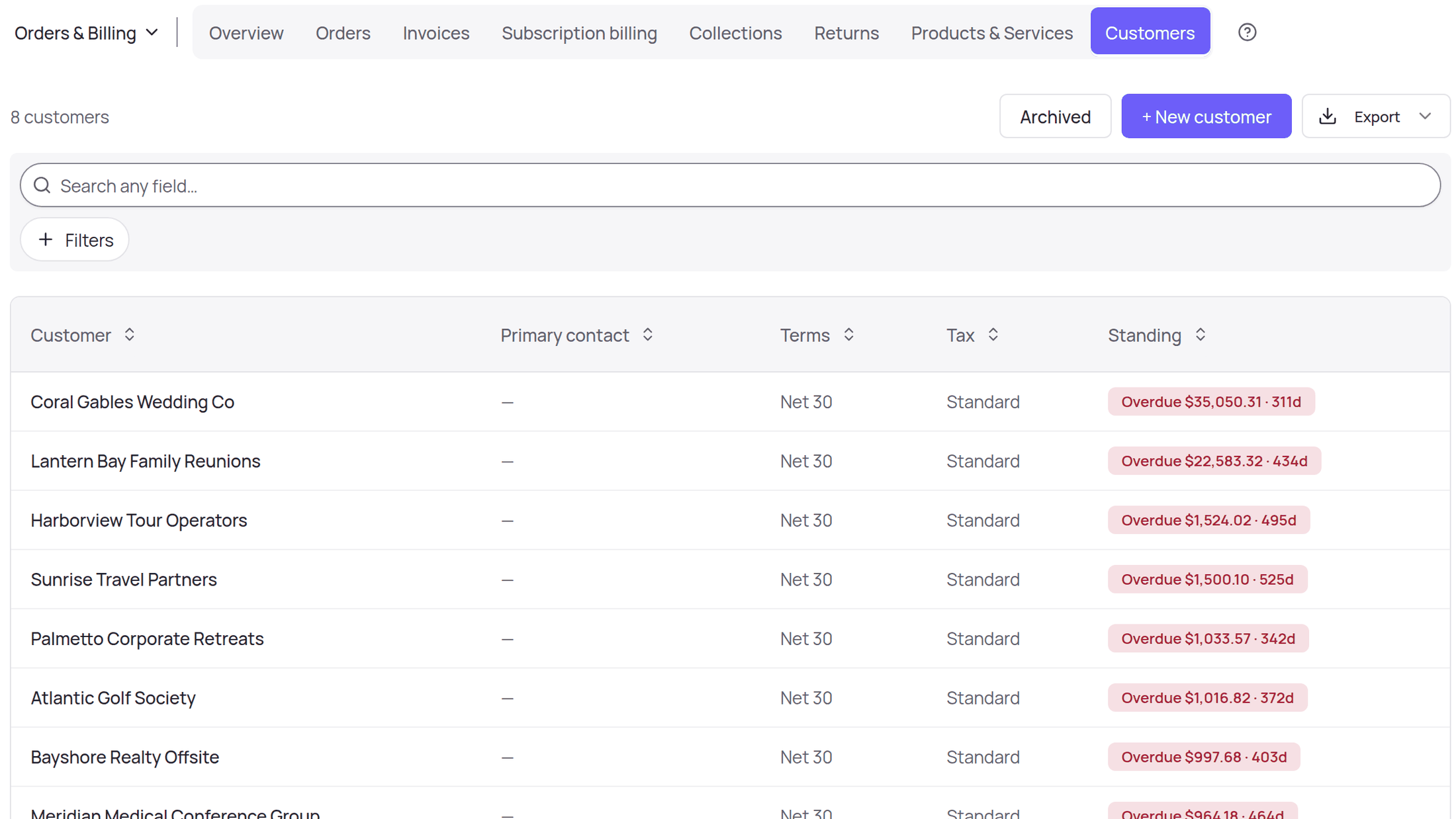
The customer in your CRM is the record AR bills and the ledger reports on. One contact master across sales, billing and the books, so a prospect becoming a customer is a status change, not a re-keying exercise.
- Account 360 merges logged calls, emails and notes with the real events: invoice issued, invoice paid, deal won, contract signed
- People carry employment stints and standing designations, Economic Buyer, Champion, Technical Buyer, AP Contact and more
- Merge duplicate people, move a person between accounts, restore an archived prospect
- Hosted lead-capture forms on a public link, resolving the account by corporate email domain and deduping the person before it creates one
- CSV import with an AI-proposed column mapping you can edit, a live preview, and dedup at the account level
- A whole pipeline imported from a spreadsheet lands as one batch, undone in a click if it came in wrong
Meetings and calendar
Connect a rep’s Google Calendar and the sync flags the events whose attendees match a CRM contact. Before the call, Kate writes a briefing book from real rows only, the account, the open deals, the notes, who is attending and their role, and she is instructed to say when the history is thin rather than invent any.
- Meeting summaries arrive by webhook from Fireflies and Fathom, reading the provider’s summary fields only, never a transcript
- Paste an email thread or call notes and Kate proposes the activity, the people and the next step for you to confirm
- A note that says “follow up in three weeks” schedules the task, with no model involved, and emails the owner the day it comes due
- Synced Google contacts land in a triage inbox as suggestions you confirm, link or dismiss. Recommend, never auto-link
- Calendar, contact sync, Google Meet summaries, and the Salesforce and HubSpot importers are switched on per company, not on by default
Forecast and analytics
A deterministic revenue forecast, stage-weighted by close period with commit and best-case bins, feeding the same planning engine your budget lives in. Sales and finance read one number because there is only one.
- Stage probability calibrated from your own won and lost history
- Stage funnel, velocity, cycle days and win rate in a Performance Center
- Every view scopes to All, My deals, My team, a department or a pursuit team
Commissions
Computed from the won deals already in the system, so nobody exports anything to reconcile it. Tiered rates, accelerators, quota attainment, ramp, draws and clawback, with a statement per rep.
- ASC 340-40 treatment: capitalize the cost of obtaining the contract, amortize it over the resolved period, apply the practical expedient where it qualifies
- Claw back on a qualifying event
The screen that tells you what to do today.
Not a dashboard of everything. One ranked queue of the deals that genuinely need a human, each row saying why it is there and how many days it has sat, ordered by the money at risk.
- Two reasons put a deal on the list. No scheduled next step, or idle past its stage’s window.
- Won but uninvoiced is its own number, because that is cash parked in the CRM.
- Today’s and overdue activities, every row clicking through to the record it belongs to.
- Your own activity categories each get a live card, so the deck matches how your team actually sells.
- It respects the visibility policy, so a rep’s deck holds a rep’s deals and nothing else.
Questions the pipeline can answer, asked in a sentence.
Kate reads the same rows the board renders, by chat or live voice. When she changes something she drafts it and hands you the control, she never writes on her own.
No seat math. No CRM line on your bill.
This is the HubSpot or Salesforce bill, the quoting tool next to it, and the commission spreadsheet underneath, done once. Per-seat pricing punishes you for letting people collaborate, and a pipeline only pays off if everyone keeps it current, so the CRM comes with the platform from the Launch plan up, whether four people use it or four hundred.
- Included from Launch, $99 a month, and on Growth and Scale above it. Unlimited users on every plan.
- Quotes, forecasting and commissions are part of it, not three more subscriptions.
- Turning a won deal into a subscription uses the Revenue Suite module, one flat price, switched on the month you need it.
- Month to month, and your data exports in full whenever you ask.
The deal is just the beginning.
Move the pipeline in. Retire the per-seat bill.
We’ll import your deals, contacts and quotes, then walk one deal from first call to posted revenue on data that looks like yours.
Let’s begin