A ledger that closes itself. Continuously.
A real double-entry ledger where entities, currencies and dimensions are modeled objects. 9 subledger families tie out to the GL as live invariants, 44 control rules scan the books, and a locked period refuses the write in the ledger spine itself. Month-end has nothing left to start.
Consolidation-grade depth, without the implementation.
What mid-market teams usually buy an enterprise suite to get, native here.
The ledger itself
Double-entry, with the balance validated on the server rather than in the browser. Entries go draft then post, with maker-checker approval where a company requires it, and a self-approved entry raises its own exception.
- Reverse, void with approval, duplicate, and auto-generate next period’s reversing entry
- Recurring journal entries and recurring bills on a scheduled generator
- A posted entry is never edited in place. It is voided and re-created, or corrected by an entry that says so
- On a reconciled bank line, move the account with a pencil and the correction posts as its own entry
- Re-tag that line’s business partner or dimensions the same way. A reporting tag is written in place, a balancing one posts a correcting entry so the due-to and due-from legs stay true
Dimensional ledger
Entity, fund, department, location, project, class and your own custom dimensions are first-class modeled objects, not columns bolted onto the chart of accounts. A balancing dimension has to net to zero inside every value, so the due-to and due-from legs are generated at write time.
- Several balancing dimensions solved at once, entity and fund together
- Every statement sliceable by any dimension
- Intercompany transfers tag each leg’s entity structurally, with approve and release
Multi-currency
Money is an object with a currency attached, not a bare number. Each entity carries its functional currency, transaction FX is applied at post time, and every line stores its reporting-currency equivalent. Rate tables pull daily ECB reference rates from a feed, with month-end and average rates derived from them.
- Realized FX gain and loss posted on AP and AR settlement
- Period-end revaluation of open AR, AP and foreign cash to the closing rate, posted per entity so each still self-balances
- Nothing waits on someone remembering a month-end adjustment
Consolidation and reporting basis
Group reporting is computed from the one ledger. Consolidating income statement, balance sheet and cash flow, a column per entity, an automatic eliminations column, and local to group chart mapping for subsidiaries that keep their own chart.
- Non-controlling interest income and equity split from ownership percentages
- CTA from current-rate retranslation, recycled when an entity is disposed
- US GAAP or IFRS as a flag over the same ledger, with a LIFO guard, OCI and a statement of changes in equity. Never a second set of books
Subledgers, on the same ledger
The subledgers a point solution bills you separately for, posting into these books rather than arriving as a monthly journal entry someone pastes in.
- Fixed assets as a real register: book and tax MACRS, CIP accumulation, impairment, partial disposal that rebases the remaining schedule, and a CSV import that seeds mid-life accumulated depreciation and depreciates only the remainder
- ASC 842 and IFRS 16 leases and debt amortization, with terms extracted from the document by AI and confirmed by a person
- Inventory costed FIFO, LIFO or weighted average, with COGS posted from the layers actually consumed
- Prepaid, accrual, deferral, depreciation and deferred-revenue schedules that post their own balanced entry each period
Statements and reporting
Income statement, balance sheet, cash flow, trial balance, changes in equity and comprehensive income. Scope any of them by entity, dimension slice, reporting basis, reporting currency, and cash versus accrual. Click a line and keep going until you reach the journal line under it.
- Prior period, prior year, N comparison columns, automatic quarter detection
- 90 templates in the report gallery, 84 live today, tagged by role and by category
- Export to CSV, XLSX and PDF, email to a named list, or take a point-in-time snapshot and share it
- GAAP disclosure notes computed from the balances, with drafted narrative you edit
The books most systems make you leave
Fund accounting, equity and profit sharing run on the same dimensional spine rather than in a spreadsheet nobody can audit.
- Nonprofit: net-asset classes with release of restriction, statement of activities, functional expenses, grants with encumbrance and available balance
- Equity and cap table: share classes, option pools, vesting, SAFE and note conversion, 409A, exit waterfall, fully diluted math
- Capital accounts and distribution waterfalls with recoupment, preferred return and splits, dry-run before you settle
Getting your books in
A seeded default chart or your own by CSV, parent and rollup accounts, archive, and an AI-proposed restructure you preview before applying.
- Opening-balance capture and a migration wizard
- QuickBooks and Xero import, plus live QuickBooks Online write-back while you transition
- Guided migration is included on Scale
What it does not do
Said here rather than in month two.
- No tax filing. Tax is a mapping and export layer: a tax-line-tagged trial balance, Schedule L, 1125-A and 1125-E, M-1, 4562 rows, K-1 allocation and a state filing register, exported into professional tax software. Caytava never signs or files a return, by design
- CTA and non-controlling interest are computed at statement time. They are not carried as posted GL balances
- No XBRL and no statutory reporting packs. IFRS 18’s presentation categories take effect on 1 January 2027 and are not built yet
Every line can tell you who coded it.
Coding runs down one ladder. The first rung that can decide, decides, and the rung that decided is recorded on the transaction. There is no IRS-style category anywhere in it. A decision is an account.
User decision
Someone recorded the account on that line. It is a direct account choice, and nothing below it gets to overrule it.
Your rules
A rule a person in your company wrote, which can also carry the dimensions and the business partner. Rules apply on their own because a human authored them and owns them. Preview a recode before it runs, then bulk-apply it.
This company’s own machine learning
Patterns learned only from your confirmed decisions. Confidence is an observed agreement rate, not a model score: of the similar lines your people coded, what share went to this account. It takes at least five human-coded neighbors and 90% agreement by default, and you can ask to see them.
AI, always queued
Only for lines nothing above can explain. It proposes in words, never a percentage and never a count of what other companies did. It never posts. Accepting one records a user decision.
Human review
Whatever is left. What you decide becomes a user decision, and can be promoted into a rule so the same line never asks twice.
- Ask any line why. The trace names each rung and what it said: coded it, matched but outranked, no match, not applicable. A rule shows as a link to the rule, because a rule is a thing somebody owns.
- The same ladder runs for every facet. Business partner and each dimension resolve the same way, with one extra rung above rules: ledger evidence. A bank line matched to a bill inherits that bill’s counterparty and its dimension tags. Entity comes from the connection and is never predicted.
- A statement has to prove itself. Opening balance plus the parsed lines must equal the closing balance or the import is refused at the door, with the exact arithmetic in the error. An unfootable layout can be forced through explicitly.
- Matching works the same way. Write a match rule in plain terms, or let patterns from your own confirmed matches fire at five examples and 90% agreement. AI residue is queued. Every suggestion names the rung it came from.
A lock you can verify, not a flag in a screen.
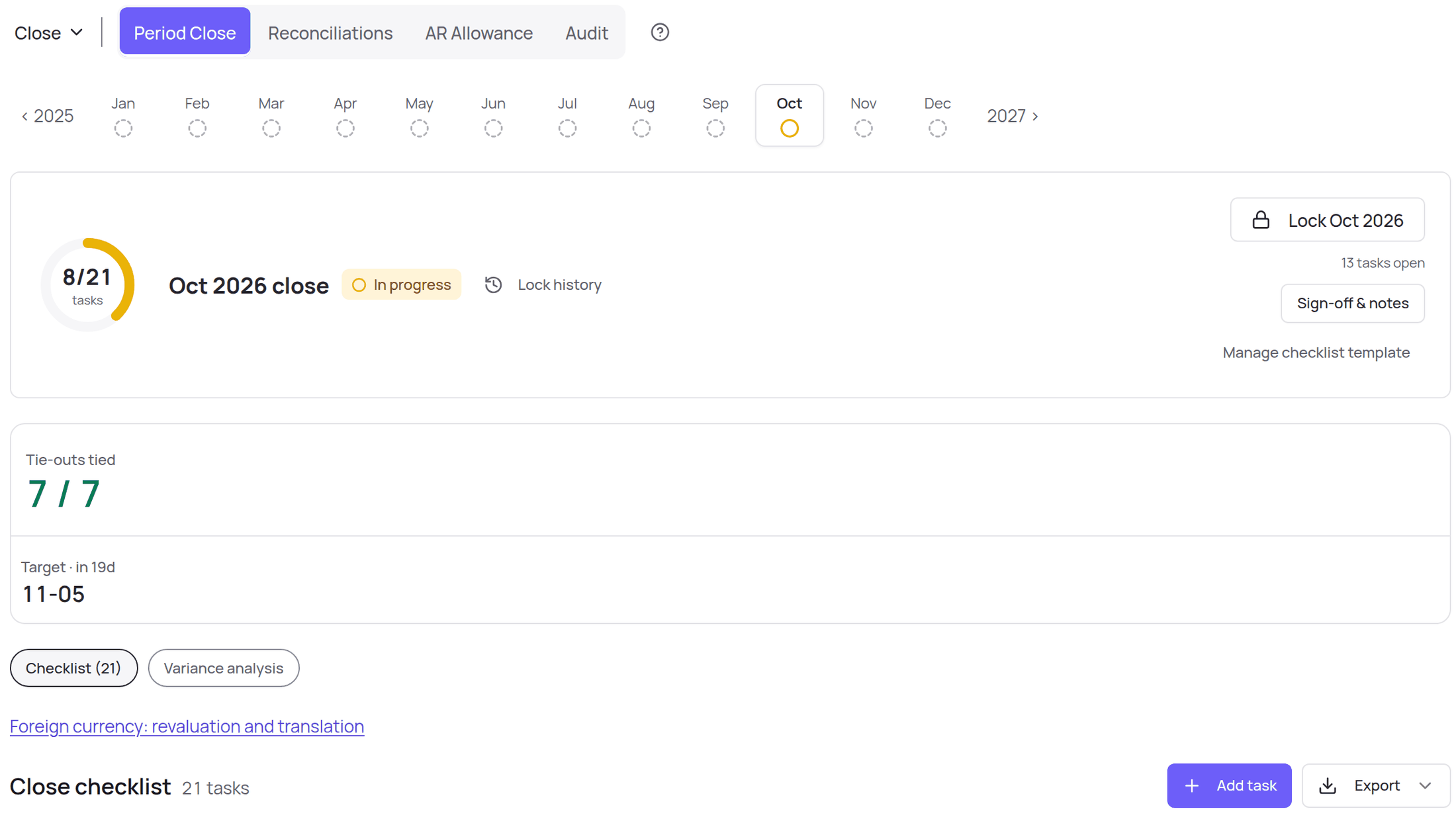
The period lock lives in the ledger spine, so every posting path is covered and a locked period structurally rejects the write. Closing writes a snapshot hashed with SHA-256 that can be re-verified later, and next period’s opening balance is the prior period’s locked close.
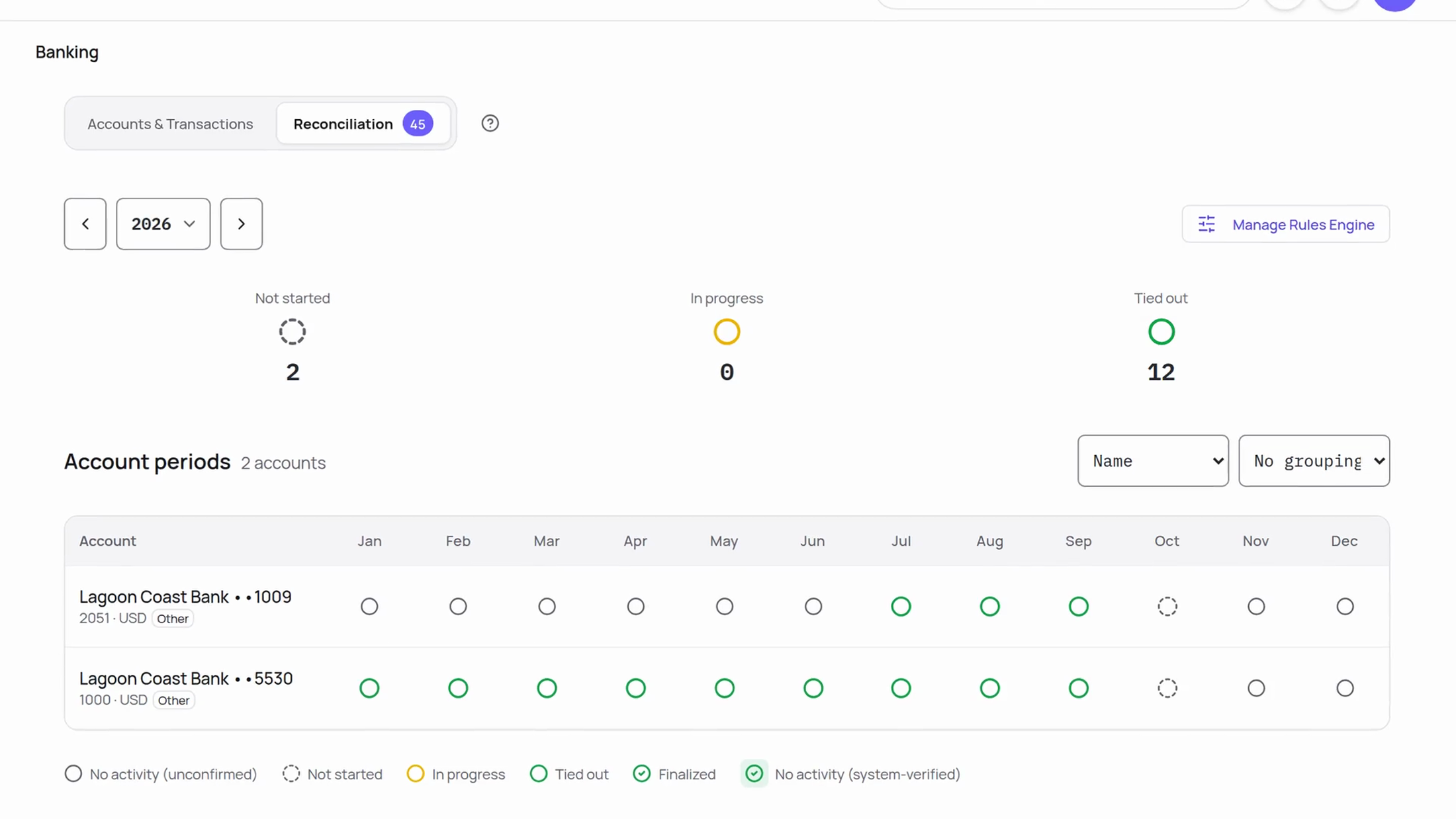
- 9 subledger families tie to the GL continuously, from AR and AP through fixed assets, leases, debt, inventory and the schedules. Tolerance-based, entity-scoped, and checked as an invariant, so a break flags when it happens rather than at month-end.
- 44 control rules scan the ledger and name the record: a merchant coded across several accounts, a bill approved with no purchase order, an entry approved by the person who wrote it, an asset capitalized under your own threshold, revenue recognized off your stated policy.
- Certifications with a real second pair of eyes. A preparer signs, a different reviewer approves, enforced on the server. The balance is stamped and the item list behind it frozen as the workpaper. If the balance moves after sign-off, the row de-certifies itself.
- Close cycles and tasks from templates, with assignment, review and sign-off. Some tasks verify themselves: a tie-out task completes when the tie-out actually ties.
- Reopen a period and the re-sweep restates the periods after it. Reopening is a reserved capability a broad Manage badge does not inherit.
- Your auditor gets a scoped identity: PBC request lists, deliverables through submit, review and release by an independent checker, and a trial balance, statements, aging, fixed assets and deferred revenue pulled straight from the books.
Talk to the ledger, by chat or live voice.
Every figure Kate gives you comes from a real query against your books, never model arithmetic over retrieved text. When you ask her to do something, she drafts it and an inline card appears. You approve, and deterministic code does the write.
The ledger is in every plan. Depth switches on.
The plan you need is decided by what your books have to do, not by how many people sign in to them. Unlimited users on all four, and your accountant’s login is free.
- Solo, $59 a month. The full double-entry ledger, bank feeds, reconciliations, AI coding you approve, statements and comparatives, and up to 25 fixed assets added each month.
- Launch, $99. Adds the month-end close checklist and balance-sheet reconciliations, budgets, CRM and core HR.
- Growth, $399. Adds subledger tie-outs and the exception engine, departments, projects and locations on every entry, and approvals with segregation of duties.
- Scale, $999, for $50M and up. Adds the auditor workspace and evidence packs, access certification, quorum approvals and break-glass, and custom balancing dimensions for funds, grants and programs.
- Depth is a module you switch on. Multi-Entity & Global is $600 a month flat, whether you run two entities or fifty. Lease Accounting is $300, IFRS Reporting $750, GAAP Disclosures $450. Inventory & Order Ops starts at $350 and is priced by units held.
It’s one ledger all the way down.
Watch a close that never stops running.
Thirty minutes on your own books: the tie-outs, the trace on a line you pick, and what the 44 rules find.
Let’s begin